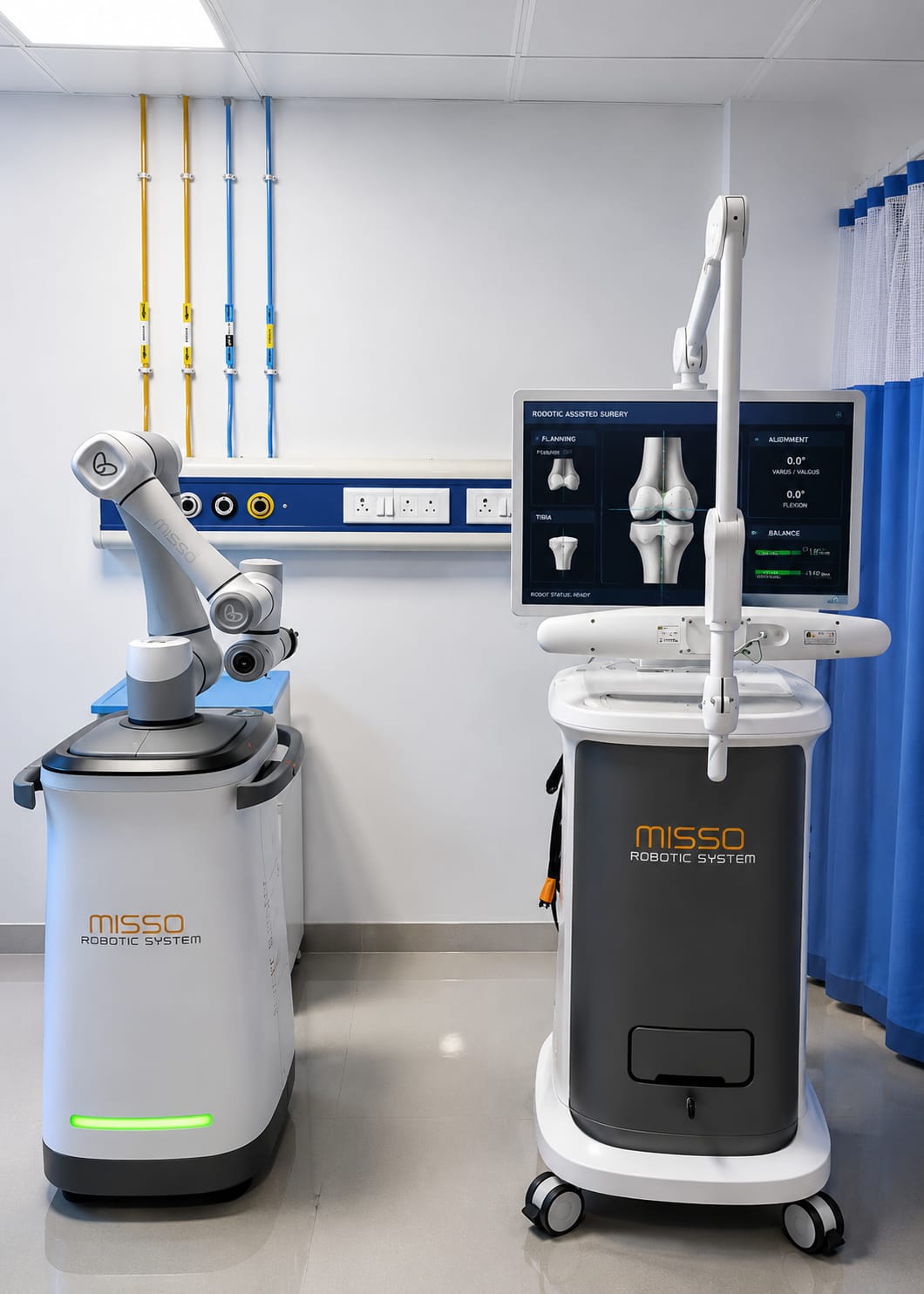
Comprehensive orthopaedic care for patients with painful or damaged knee joints, with a focus on relieving pain, improving mobility and supporting a better quality of life.
Advanced robotic-assisted treatment for knee conditions
Robotic-assisted surgical treatment for damaged knee joints
Support for recovery and improved mobility
Learn more about Total Robotic Knee Replacement, the procedure and recovery journey.
Robotic Knee Replacement, also known as Robotic Knee Arthroplasty, is a surgical procedure in which damaged parts of the knee joint are replaced with artificial components.
It may be considered when knee pain, stiffness or joint damage significantly affects walking, movement and everyday activities.
Each patient is evaluated individually by the orthopaedic team to determine the most appropriate treatment.
The orthopaedic team evaluates the patient's symptoms, examination findings and imaging before recommending treatment.
Severe arthritis can cause pain, stiffness and difficulty with walking and daily activities.
Loss of blood supply to the femoral head can result in progressive damage to the knee joint.
Certain severe knee joint injuries may require joint replacement depending on the patient's condition.
Robotic knee replacement may help reduce pain associated with severe joint damage.
Treatment aims to improve movement and functional ability following recovery.
Successful treatment may help patients return to many everyday activities.
Clinical assessment of symptoms, medical history and knee condition.
Appropriate investigations and treatment planning.
Damaged portions of the knee joint are replaced with artificial components.
Guided rehabilitation supports recovery and mobility.
Recovery varies between patients and depends on individual health and rehabilitation needs.
Appropriate movement and walking exercises may begin under medical guidance.
Rehabilitation can help restore strength, balance and mobility.
Regular follow-up helps monitor healing and recovery progress.
Robotic Knee Replacement is a surgical procedure in which damaged parts of the knee joint are replaced with artificial components.
It may be considered for patients with significant knee pain or joint damage affecting mobility and daily activities. The orthopaedic team determines suitability after evaluation.
Recovery varies from patient to patient. The treating orthopaedic team will provide an individualized rehabilitation plan.
Appropriate rehabilitation and physiotherapy are important parts of recovery following robotic knee replacement.
For evaluation of knee pain or discussion of treatment options, contact the Department of Orthopaedics at The Oxford Medical College, Hospital & Research Centre.
Contact Orthopaedics